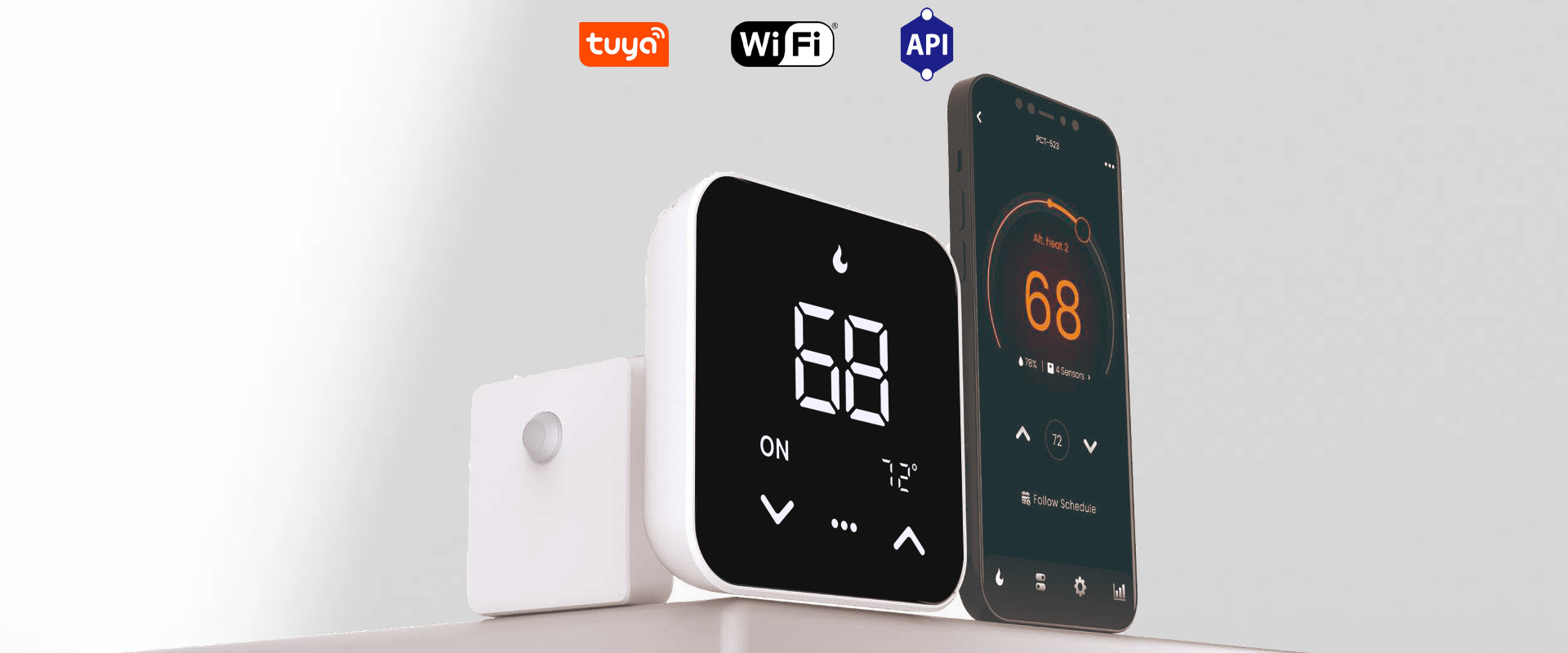
WiFi 24VAC HVAC Control Solution for Residential and Light Commercial Systems
Modern North American HVAC systems require more than simple temperature control. Multi-stage heating and cooling, heat pump optimization, dual fuel switching, humidity management, and remote zoning have become standard expectations in residential and light commercial environments.
OWON’s WiFi 24VAC HVAC Control Solution is designed to support advanced low-voltage HVAC systems, providing stable connectivity, flexible installation, and scalable system integration capabilities.
This solution integrates professional-grade WiFi thermostats, remote zone sensors, retrofit power modules, and open API architecture to support residential HVAC manufacturers, contractors, telcos, utilities, and smart home platform providers.
Understanding 24VAC HVAC Architecture
Most North American HVAC systems operate on 24VAC low-voltage control logic. Typical configurations include:
-
2H/2C conventional systems
-
4H/2C multi-stage heat pump systems
-
Dual fuel (hybrid heat) systems
-
Auxiliary and emergency heat
-
Furnace + AC combinations
-
Humidifier and dehumidifier control
Thermostats deployed in these systems must manage staging logic, compressor delay protection, temperature swing adjustment, and automatic heat/cool changeover.
OWON WiFi thermostats are engineered specifically for these system requirements.
Multi-Stage & Heat Pump Compatibility
OWON’s WiFi HVAC portfolio supports a wide range of HVAC configurations.
For conventional and hybrid heat systems, the PCT523 24VAC WiFi thermostat supports 2-stage heating and 2-stage cooling systems, as well as dual fuel switching and emergency heat support.
For advanced installations requiring enhanced interface and extended system control, the PCT533C multi-stage heat pump thermostat provides a 4.3-inch full-color touchscreen, auxiliary heat management, emergency heat support, and installer-level configuration menus.
For zoning-focused deployments, the PCT513 WiFi touchscreen thermostat with remote sensors supports up to 16 remote zone sensors, enabling room prioritization, occupancy-driven HVAC logic, and elimination of hot or cold spots throughout the home.
This structured product portfolio allows HVAC partners to deploy the appropriate thermostat tier depending on project positioning.
Remote Zone Sensor Integration
Temperature imbalance is common in multi-room homes.
OWON WiFi thermostats support wireless remote sensors to:
-
Prioritize occupied rooms
-
Enable occupancy-based temperature adjustment
-
Improve overall system efficiency
-
Balance temperature distribution across floors
Models such as PCT513 and PCT523 support remote sensor pairing for multi-room comfort optimization, making them suitable for large residential deployments.
Retrofit-Friendly Installation (C-Wire Solution)
One major installation barrier in older homes is the absence of a C-wire.
To address this, OWON provides the SWB511 C-wire adapter module, which reconfigures existing wires to supply continuous 24VAC power without the need to run new wiring through walls.
This simplifies retrofit projects and reduces installation cost for contractors.

Advanced HVAC Control Features
Across the WiFi thermostat portfolio, key control features include:
-
7-day programmable scheduling
-
Up to 8 periods per day
-
Vacation mode
-
Smart warm-up and precooling
-
Adjustable temperature swing
-
Compressor short-cycle protection
-
Dual transformer compatibility (Rc/Rh)
-
Humidity sensing and control
-
Energy usage tracking
These features make the platform suitable for both homeowner comfort and utility energy programs.
System Architecture
OWON WiFi HVAC solution follows a layered architecture:
Device Layer
-
PCT523 WiFi 24VAC Thermostat
-
PCT533C Touchscreen Thermostat
-
PCT513 Zoning Thermostat
-
Remote Zone Sensors
-
SWB511 Power Module
Connectivity Layer
-
WiFi communication
-
Device-level API
-
MQTT / HTTP integration capability
Application Layer
-
Mobile APP control
-
Third-party cloud integration
-
Smart home ecosystem compatibility
-
Energy monitoring dashboards
This modular structure enables flexible deployment across residential and light commercial properties.
Typical Deployment Scenarios
-
North American HVAC manufacturer integration
-
Smart thermostat OEM programs
-
Telco-driven home automation projects
-
Utility-sponsored energy efficiency programs
-
Contractor-grade multi-property deployments
-
Residential zoning and retrofit upgrades
Designed for Professional HVAC Deployment
OWON WiFi thermostats are built for installer-level configuration, including:
-
Built-in installer menus
-
Equipment test mode
-
Adjustable compressor delay
-
Emergency heat configuration
-
Multi-level keypad lockout
-
Firmware upgrade capability
Premium touchscreen models such as PCT533C provide enhanced UI and diagnostic capability, while PCT523 offers a streamlined contractor-grade design for large-scale deployment.
Integration & Platform Flexibility
Beyond device control, OWON WiFi HVAC devices provide:
-
Device-level API
-
Cloud-level API
-
MQTT integration
-
Custom firmware capability
-
Flexible communication module integration
This allows HVAC manufacturers, system integrators, and IoT platforms to integrate thermostats into their proprietary ecosystems.
Why Choose OWON WiFi HVAC Platform
-
Full 24VAC HVAC compatibility
-
Multi-stage & dual fuel expertise
-
Remote zone sensor ecosystem
-
Retrofit-friendly C-wire solution
-
API-based integration capability
-
In-house IoT R&D and manufacturing
-
Scalable architecture for residential and light commercial markets
Frequently Asked Questions
What is a 24VAC WiFi thermostat?
A 24VAC WiFi thermostat is a low-voltage HVAC controller used in North American systems to manage heating, cooling, and heat pumps with wireless connectivity and remote management capability.
Can OWON WiFi thermostats support dual fuel systems?
Yes. Models such as PCT523 and PCT533C support hybrid heat systems that automatically switch between furnace and heat pump.
Does the thermostat require a C-wire?
Most installations require a C-wire. For retrofit cases without a C-wire, the SWB511 power module provides an alternative solution.
Are remote room sensors supported?
Yes. PCT513 and PCT523 support multiple remote zone sensors to enable prioritized temperature control.
Next Step
If you are evaluating a WiFi 24VAC HVAC control platform for residential or light commercial deployment, system compatibility, staging logic, zoning capability, and integration flexibility are critical factors.
OWON provides a structured WiFi thermostat portfolio that supports multi-stage systems, zoning control, retrofit installation, and scalable platform integration.
Contact our team to discuss your HVAC project requirements.