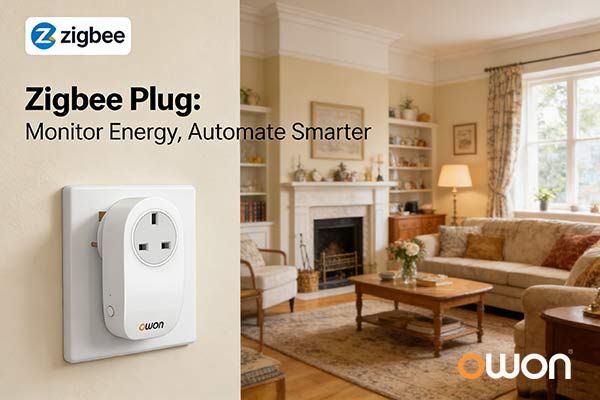
A Zigbee plug with power monitoring is becoming a foundational component in modern smart building and Home Energy Management Systems (HEMS). By providing appliance-level visibility—real-time power, usage patterns, and accumulated energy (kWh)—it helps utilities, system integrators, hospitality operators, and energy platforms optimize loads, reduce waste, and improve operational efficiency.
Unlike many WiFi smart plugs that rely heavily on router capacity and cloud connectivity, a Zigbee plug with energy monitoring operates within a self-healing mesh network designed for scalable IoT deployments. This matters in real projects—hotels, multi-family housing, and light-commercial buildings—where dozens or hundreds of endpoints must remain stable over long lifecycles.
OWON is an ISO 9001:2015 certified IoT device manufacturer established in 1993, specializing in Energy Management, HVAC Control, and Smart Building IoT. For professional deployments, OWON offers Zigbee energy monitoring smart plugs including WSP403 (global version) and WSP404 (US version), plus a broader Zigbee ecosystem (gateways, meters, relays, sensors) and OEM/ODM support to help partners scale reliably.
Why WiFi Smart Plugs Often Fail at Scale
WiFi plugs are common in retail markets, but large-scale deployments quickly expose structural limitations:
-
Router bottlenecks: more devices compete for bandwidth and airtime
-
Latency instability: response times vary under network load
-
Cloud dependence: automation and monitoring can degrade during outages
-
Maintenance overhead: troubleshooting grows as device count increases
-
RF congestion: dense environments reduce reliability
For B2B energy monitoring, these issues impact not only user experience but also data consistency—directly affecting analytics, billing logic, and optimization outcomes.
Zigbee 3.0 Mesh Networking: Built for Reliability and Coverage
Zigbee 3.0 forms a self-healing mesh network where powered devices can act as routers, naturally extending coverage as more devices are deployed. For smart buildings and HEMS projects, this architecture provides:
-
Scalability: each added plug strengthens the network instead of burdening a central router
-
Resilience: gateway-based automations can run locally, reducing cloud dependency
-
Consistency: stable connectivity improves the integrity of metering data and control commands
Zigbee vs WiFi Smart Plug: Deployment-Level Comparison
| Factor | Zigbee Smart Plug | WiFi Smart Plug |
|---|---|---|
| Network topology | Mesh (self-healing) | Star (router-dependent) |
| Scaling beyond 20–50 devices | Naturally extensible | Router capacity becomes a bottleneck |
| Local automation | Common via gateway | Often cloud-centric |
| Dense RF environments | Generally more stable | Often degrades as devices increase |
| Best fit | Smart buildings, hotels, HEMS/BMS | Small residential setups |
If your project depends on long-term stability and repeatable deployments, Zigbee’s architecture is usually the safer choice.
Power Monitoring That’s Actually Useful for Energy Management
In energy management, “monitoring” must be consistent, calibrated, and actionable. A professional Zigbee monitoring plug should support:
-
Real-time power tracking and accumulated energy (kWh)
-
Stable reporting behavior under varying loads
-
Data suitable for peak demand detection and load optimization
-
Reliable switching for scheduled control and automation
With appliance-level data, platforms can enable:
-
Peak load alerts (e.g., abnormal heater draw)
-
Tariff-based scheduling (shift non-critical loads off-peak)
-
Plug-load audits (hotel rooms, rentals, offices)
-
Solar self-consumption optimization (use surplus PV locally)
-
HVAC accessory control (fans, dehumidifiers, window A/C coordination)
This is why Zigbee monitoring plugs are often deployed as long-life data nodes within a system—not just “remote switches.”
10A vs 15A: Choose the Right Plug for the Market and Load
Load capacity determines where the device can be safely deployed and what appliances it can serve.
Decision Table: Global vs North American Use Cases
| Selection factor | Global multi-voltage version (typical 100–240VAC) | North American high-load version (typical 120–125VAC) |
|---|---|---|
| Primary market | EU/UK/AU + global distribution | USA & Canada |
| Typical load profile | Lighting, small appliances, room plug loads | Heaters, window A/C, kitchen appliances |
| Deployment pattern | Hotels, apartments, multi-room retrofits | HVAC-heavy homes, hospitality rooms |
| Why it matters | Simplifies logistics across regions | Matches real appliance current demand |
OWON product mapping
-
OWON’s WSP403 Zigbee smart plug with energy monitoring fits global deployments where multi-voltage compatibility, stable mesh routing, and accurate metering are required across many rooms or units.
-
For North American projects, the WSP404 Zigbee plug USA version is aligned with higher-load applications where heaters, window AC units, and kitchen appliances demand reliable 15A performance.
Integration Architecture: From Plug-Level Data to Platform Intelligence
A Zigbee plug with power monitoring delivers maximum value when it’s part of a layered architecture:
-
Device layer: plug-level switching + metering
Gateway layer: Zigbee gateway for mesh networking and data aggregation, supporting stable device communication and local automation rules
Platform layer: analytics, dashboards, alerts, optimization logic (cloud or private deployment)
Application layer: web dashboards, mobile apps, partner platforms
For B2B projects, this architecture supports repeatable deployment across:
-
Smart hotels and guest-room energy controls
-
Multi-family energy visibility programs
-
Light-commercial retrofits
-
Utility or telco managed HEMS programs
-
Demand response and load shedding scenarios
Real-World Scenarios Where Zigbee Monitoring Plugs Add Measurable Value
1) Hospitality plug-load optimization
Monitor and schedule high-frequency plug loads (kettles, lamps, fans), reduce standby waste, and support operational visibility across rooms.
2) Multi-family deployments
Standardize device-level monitoring for tenant analytics, abnormal load alerts, and scalable retrofits without rewiring.
3) HVAC accessory coordination
Control and monitor portable heaters, window A/C units, dehumidifiers, and fans as part of a broader HVAC strategy.
4) Solar + EV load coordination
Use plug-level metering to detect surplus production and shift discretionary loads to maximize PV utilization.
How OWON Supports Professional Zigbee Energy Monitoring Projects
For system integrators and solution providers, long-term success is determined by more than hardware specs. OWON supports partners with:
-
Architecture consultation: load profiles, deployment scale, and product selection
-
Zigbee network planning: mesh topology guidance and pairing workflows
-
Integration readiness: gateway-based aggregation and platform connectivity planning
-
OEM/ODM services: branding, packaging, firmware behavior alignment, certification planning
-
Lifecycle support: documentation, stable supply, and engineering collaboration
This project-oriented approach helps reduce deployment risks and speeds up time-to-market for energy platforms and smart building solutions.
Conclusion
A Zigbee plug with power monitoring is not just a consumer gadget—it is a scalable data node and control point within modern energy management systems. For projects that require stable networking, consistent metering, and integration flexibility, Zigbee’s mesh architecture provides long-term advantages over router-dependent approaches.
For global deployments, multi-voltage designs support wide distribution and retrofit simplicity. For North America, high-load designs align with real appliance demands while maintaining monitoring accuracy and operational safety.
If you are building a HEMS/BMS platform or sourcing Zigbee monitoring plugs for a professional rollout, contact OWON for product selection, samples, and OEM/ODM collaboration.
Post time: Mar-03-2026