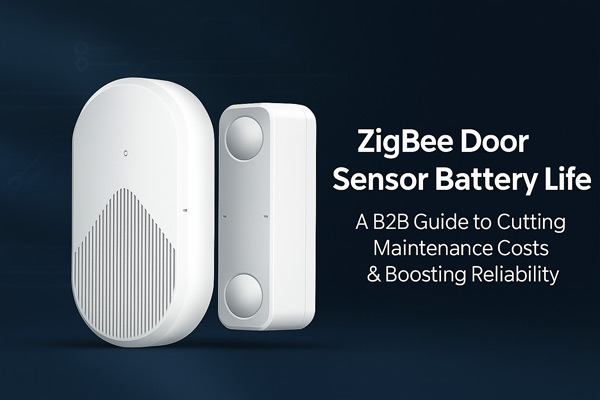
For system integrators, hotel operators, and facility managers, Zigbee door sensor battery life is a critical factor when deploying smart building security and automation systems. In large commercial environments, hundreds of Zigbee door sensors may be installed, making battery performance a key consideration for long-term maintenance costs, system reliability, and operational efficiency. Compared with consumer-grade sensors, commercial Zigbee door sensors must maintain stable battery performance under frequent open and close events in hotels, offices, and large facilities.
Why ZigBee Door Sensor Battery Life Matters for B2B Operations
B2B environments—from 500-room hotels to 100-warehouse logistics centers—amplify the impact of short battery life. Here’s the business case:
- Maintenance labor costs: A single battery replacement takes 15 minutes; for 200 sensors, that’s 50 hours of technician time annually.
- Operational downtime: A dead sensor means lost data on door access (critical for compliance in healthcare or retail).
- Scalability limits: Short-lived batteries make it impractical to deploy sensors across large campuses.
Unlike consumer-grade sensors (often marketed with “1-year battery life”), commercial-grade ZigBee door sensors need to deliver consistent performance under heavy use—think 50+ daily door triggers in a hotel hallway or industrial facility .
The Science Behind Long-Lasting ZigBee Door Sensors
In many smart building deployments, Zigbee door sensors are installed together with
Zigbee window sensors to monitor open and close status across large facilities. Consistent battery performance across these sensors ensures stable long-term operation for building management systems.
Battery life isn’t just about the battery itself—it’s a balance of hardware design, protocol optimization, and power management. Key technical factors include:
1. Low-Power Component Selection
The most efficient ZigBee door sensors use 32-bit ARM Cortex-M3 processors (like the EM357 SoC) that draw just 0.65μA in deep sleep . Pairing this with low-consumption reed switches (which use no power until triggered) eliminates “phantom drain” that shortens battery life.
2. ZigBee Protocol Optimization
Standard ZigBee devices send frequent status updates, but commercial-grade sensors use two critical tweaks:
- Event-driven transmission: Only send data when the door opens/closes (not on a fixed schedule).
- Mesh network efficiency: Relaying data through nearby sensors reduces radio active time .
3. Battery Chemistry & Management
Lithium coin cells (e.g., CR2477) outperform AAA batteries for B2B use—they resist self-discharge (losing just 1% charge monthly) and handle temperature fluctuations (-10°C to 50°C) common in commercial spaces . Reputable manufacturers also account for battery derating (adjusting for internal resistance) to avoid overpromising life .
B2B Application Scenarios: Battery Life in Action
Real-world use cases show how tailored battery performance solves specific commercial challenges:
1. Hotel Guest Room Security
A 300-room boutique hotel deployed ZigBee door sensors to monitor minibar and balcony door access. Initial consumer-grade sensors (6-month battery life) required quarterly replacements—costing $12,000 in labor annually. Switching to 2-year battery sensors cut this expense by 75%.
OWON Advantage: The
OWON DWS332 ZigBee door sensor uses a CR2477 lithium battery and event-driven transmission, delivering 2 years of life even with 40 daily triggers—ideal for hotel guest rooms and staff corridors.
2. Industrial Warehouse Compliance
A logistics firm needed sensors to track loading dock door closures (for temperature control of perishables). Sensors with 18-month battery life failed to meet their 2-year audit cycle, risking FDA violations. Upgrading to sensors with extended battery life ensured continuous compliance.
OWON Advantage: OWON’s DWS332 includes a low-battery alert (sent via ZigBee mesh to the BMS) that lets teams schedule replacements during routine maintenance—avoiding emergency service calls.
3. Office Building Access Monitoring
A corporate campus with 150 meeting rooms used sensors to optimize space usage. Frequent battery deaths disrupted occupancy data, hindering facility planning. Moving to low-power ZigBee sensors eliminated data gaps.
How to Evaluate Battery Life Claims (Avoid Buyer’s Remorse)
B2B buyers often fall for vague marketing like “long battery life.” Use these criteria to verify claims:
- Test conditions: Look for specs tied to real use (e.g., “2 years with 30 daily triggers”)—not “up to 5 years in standby.”
- Component transparency: Ask if the sensor uses low-power processors and event-driven transmission.
- OEM customization: Can the supplier adjust power settings (e.g., update frequency) for your specific use case?
OWON Advantage: As a B2B manufacturer, OWON provides detailed battery life test reports for the DWS332 and offers OEM customization—from branded enclosures to tailored power management—for distributors and system integrators.
FAQ: B2B Procurement Questions About ZigBee Door Sensor Battery Life
Q1: Will battery life decrease in cold/hot environments?
Extreme temperatures (below -5°C or above 45°C) reduce lithium battery capacity by 10-20%. Choose sensors rated for your environment—like the OWON DWS332 (operating range -20°C to 55°C)—and factor in a 10% buffer for battery life estimates.
Q2: Can we use rechargeable batteries to cut costs?
Rechargeable AAA batteries have lower voltage stability and self-discharge faster than lithium coin cells, making them unreliable for commercial use. For wired deployments, ask your supplier about AC-powered variants—OWON offers custom wired options for facilities that prefer permanent power.
Q3: How do we manage battery replacements across 500+ sensors?
Prioritize sensors with remote battery level monitoring (via ZigBee gateway or cloud platform). OWON’s DWS332 integrates with Tuya Cloud and third-party wireless BMS systems, letting you track battery status in real time and schedule bulk replacements during off-peak hours.
Q4: Is there a tradeoff between battery life and sensor features?
No—advanced features like anti-tamper alerts and mesh networking can coexist with long battery life if designed properly. The OWON DWS332 includes anti-tamper detection (triggered by unauthorized removal) without sacrificing power efficiency.
Q5: What’s the minimum battery life we should accept for commercial use?
For most B2B scenarios, 1.5-2 years is the threshold. Below that, maintenance costs become prohibitive. The OWON DWS332’s 2-year battery life aligns with typical commercial maintenance cycles.
Next Steps for B2B Procurement
For system integrators and OEM partners evaluating Zigbee solutions, choosing a reliable zigbee door sensor manufacturer is just as important as selecting the right technical specifications. Stable battery life, tamper protection, and seamless Zigbee integration all contribute to long-term project success in smart building deployments.
When evaluating ZigBee door sensor suppliers, focus on three key actions:
Request sample testing
Ask for 5–10 units of a zigbee door window sensor to test battery performance and network stability in your real deployment environment, such as hotel hallways, office buildings, or warehouses.
Verify OEM and integration capabilities
Ensure the supplier can support OEM customization, firmware configuration, and integration with your Zigbee ecosystem. For example, sensors should work with platforms such as Tuya, Zigbee2MQTT, or third-party gateways used in smart building systems.
Calculate total cost of ownership (TCO)
Compare sensors with a typical 2-year battery life against 1-year alternatives. In large deployments, longer battery life can significantly reduce maintenance labor and operational costs.
For distributors and system integrators planning large-scale deployments, working with an experienced manufacturer can simplify integration and long-term device management.
Related reading:
Post time: Oct-02-2025