As distributed energy resources (DER) continue to expand worldwide, integrating solar photovoltaic systems and energy storage solutions has become a critical priority for utilities, system integrators, and inverter manufacturers. A professional smart energy meter for solar is no longer just a measurement device—it is a core component of intelligent energy management systems.
OWON provides a bidirectional smart energy meter specifically designed for seamless solar and energy storage integration, enabling real-time monitoring, inverter communication, and intelligent load optimization.
1. Why Solar and Energy Storage Systems Require Smart Metering
In solar + storage applications, accurate and real-time energy data is essential to:
-
Monitor solar generation output
-
Track grid import and export
-
Optimize battery charge and discharge cycles
-
Support net metering policies
-
Enable anti-export (zero-export) control
-
Improve overall energy efficiency
A standard energy meter cannot meet these advanced system requirements. A bidirectional smart energy meter is necessary to measure both energy consumption and solar production simultaneously.
2. Bidirectional Energy Measurement for Distributed Energy Systems
OWON’s smart energy meters support:
✔ Single-phase, split-phase, and three-phase systems
✔ Bidirectional energy measurement (import & export)
✔ Load monitoring up to 1000A via CT clamps
✔ Real-time voltage, current, power factor, and frequency tracking
✔ High installation flexibility with clamp-type design
This makes them ideal for:
-
Residential solar systems
-
Commercial rooftop PV projects
-
Industrial solar + battery installations
-
EV charging integrated with solar generation
3. Smart Meter Integration with Solar Inverters
For inverter manufacturers and system integrators, communication compatibility is critical.
OWON smart meters support:
-
Modbus RTU / TCP
-
RS485 interface
-
MQTT API
-
Wi-Fi / Ethernet / 4G connectivity
This allows seamless integration with:
-
Solar inverters
-
Hybrid inverters
-
Battery management systems (BMS)
-
Energy management platforms
By providing real-time energy data to the inverter, the system can dynamically adjust power flow, improve self-consumption rates, and support smart grid compliance.
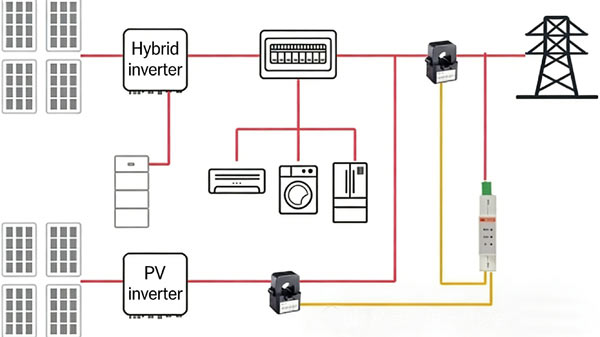
4. Enabling Energy Storage Optimization
Energy storage systems rely heavily on accurate energy data to determine:
-
When to charge from solar
-
When to discharge to loads
-
When to export to grid
-
When to store excess generation
A reliable energy storage monitoring meter ensures that the battery system operates efficiently while preventing reverse power flow issues.
OWON’s meters support integration into:
-
Home Energy Management Systems (HEMS)
-
Commercial Energy Management Systems (EMS)
-
Utility-level monitoring platforms
5. IoT Connectivity for Remote Monitoring and Data Analytics
Modern solar and storage projects often require remote monitoring capabilities.
OWON smart meters provide:
-
Real-time cloud data transmission
-
Secure MQTT API integration
-
Support for private cloud or third-party cloud
-
Multi-site centralized monitoring
This allows energy operators to:
-
Analyze system performance
-
Perform remote diagnostics
-
Optimize energy dispatch strategies
-
Support ESG and carbon reporting
6. Designed for Solar Manufacturers and System Integrators
OWON is not only a device supplier but also an IoT solution provider.
We support:
-
OEM / ODM customization
-
Flexible communication module options
-
Integration-level APIs
-
Multi-protocol compatibility
-
Rapid installation via clamp-based design
Whether you are a solar inverter manufacturer, energy storage equipment provider, or system integrator developing a solar monitoring platform, OWON delivers a scalable and integration-ready smart energy metering solution.
Conclusion
As solar generation and battery storage become standard components of modern energy systems, a reliable smart energy meter for solar and energy storage integration is essential for accurate measurement, system optimization, and regulatory compliance.
With bidirectional measurement, inverter compatibility, and IoT integration capabilities, OWON smart energy meters provide the foundation for advanced solar power monitoring and intelligent energy storage management.
Frequently Asked Questions About Smart Energy Meter for Solar
What is a bidirectional smart energy meter?
A bidirectional smart energy meter measures both electricity consumption from the grid and energy exported back to the grid from solar systems. It is essential for net metering and solar + storage applications.
How does a smart meter communicate with a solar inverter?
Most smart meters communicate via RS485 using Modbus protocol, or through IoT communication such as Wi-Fi and MQTT API. This enables real-time energy data exchange between the meter and inverter.
Can smart energy meters support zero-export control?
Yes. When integrated with compatible inverters, smart energy meters provide real-time grid flow data that enables zero-export or anti-export control strategies.
Is a smart energy meter required for energy storage systems?
Yes. Energy storage systems require accurate import/export measurement to determine charging and discharging logic. A smart energy meter ensures optimized battery operation.
Ready to Integrate Smart Metering into Your Solar or Energy Storage Project?
Selecting the right smart energy meter is not only about measurement accuracy — it is about long-term system compatibility, inverter communication stability, and scalable energy data integration.
OWON works closely with:
-
Solar inverter manufacturers
-
Energy storage equipment providers
-
EPC contractors
-
System integrators developing HEMS or EMS platforms
Our engineering team supports project-level customization, protocol alignment, and integration validation to ensure smooth deployment in residential, commercial, or utility-scale environments.
If you are developing a solar or battery system and require reliable real-time energy data integration, we are ready to support your project.
Contact OWON to discuss your integration requirements.
Post time: Feb-23-2026